Sport Law
Co-Founder/President of
Rice Sport Law Society
The Rice Sport Law Society is a student-led organization dedicated to bridging the gap between students and the dynamic world of sports law. We provide LSAT study groups, opportunities for publication, connections to alumni and industry professionals, and participation in competitions. In the future, we plan to launch a podcast platform to explore key topics like contracts, NIL, arbitration, and more. Our mission is to equip aspiring sports law professionals with the tools, experiences, and community needed to thrive in this evolving industry.


Published in Harvard
Undergraduate Law Review

In 2025, my legal article was selected for publication in the Harvard Undergraduate Law Review, a nationally recognized, student-run journal that showcases outstanding undergraduate legal scholarship. The publication represents a significant academic milestone, affirming the rigor of Rice University’s sport law curriculum and the capacity of undergraduates to contribute meaningfully to complex national legal debates.
The piece, titled “Leveling the Playing Field or Limiting It? Antitrust Challenges to the NCAA’s Proposed Revenue Sharing Cap,” examines the proposed settlement in House v. NCAA and its introduction of a 22% revenue-sharing cap on college athlete compensation derived from broadcast revenues.
At its core, the paper argues that the 22% cap functions as coordinated price-fixing in violation of Section 1 of the Sherman Antitrust Act. Through a Rule of Reason analysis, the paper contends that the cap likely restrains competition within the collegiate athlete labor market by artificially limiting athlete earnings across Division I institutions.
While the NCAA frames the cap as necessary to preserve amateurism and maintain competitive balance, the memo critically evaluates these justifications and concludes they are insufficient under antitrust doctrine, particularly where less restrictive alternatives exist. By imposing a uniform compensation ceiling without collective bargaining or union representation, the framework may operate as a de facto salary cap rather than a procompetitive reform.
This publication reflects my broader commitment to examining the structural power dynamics within collegiate athletics and to advancing scholarship that centers athlete rights, market competition, and legal accountability.


Tulane International Baseball
Arbitration Competition (TIBAC)
Rice University's Historic Achievement at Tulane's International Baseball Arbitration Competition
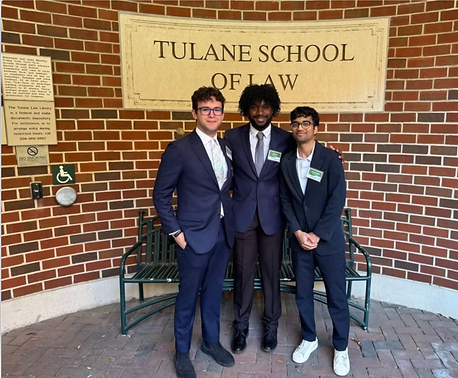
The Rice Sports Law Society, launching this spring, is proud to celebrate a groundbreaking achievement for Rice University. Our undergraduate team, led by Maya Moise, made history as the first-ever undergraduate participants at the prestigious Tulane International Baseball Arbitration Competition (TIBAC). Competing against over 40 law schools, they placed in the top third percentile overall, showcasing exceptional skill and advocacy.
TIBAC, held annually at Tulane University Law School, simulates MLB's salary arbitration process, offering participants the opportunity to hone their legal advocacy through written and oral presentations.
Andrew Ball, in his second season as Assistant General Manager for the Astros and one of this year’s TIBAC judges, praised the team, stating, “One of the most impressive teams I saw was from Rice. Not only were their arguments well-structured and logical, but they delivered their points with poise and energy. I was shocked to find out they were not law students.”
This historic performance highlights Rice University's commitment to excellence in sports law and advocacy. It also underscores the exclusive opportunities provided by the Rice Sports Law Society for students to excel in specialized legal competitions. Maya, Trevor, and Nick’s success set a new precedent for undergraduate involvement in the legal and sports management fields, inspiring future participants to follow in their footsteps.


Tulane Professional Basketball
Negotiation Competition (TPBNC)
Rice Sport Law Society will continue its national competitive expansion as the second undergraduate institution invited to compete in the Tulane Professional Basketball Negotiation Competition, a premier sport law simulation focused on real-world NBA contract negotiations. Hosted annually at Tulane University Law School, the competition places participants in high-stakes bargaining scenarios representing teams and free agents, evaluated by industry professionals. Representing Rice University, Maya Moise ’26, Aly Khanmohamed ’27, and Trent Gorsich ’29 (coached by Owen Marye '27) will compete alongside JD and MBA candidates from law schools across the country. What made this year especially meaningful was representing Rice University as the first team in Rice history to ever compete in this competition and as one of only TWO undergraduate teams in the entire competition (56 teams), competing head-to-head against first- and second-year law students from over 35 schools, including Harvard, Columbia, Georgetown, Notre Dame, Michigan, UCLA, and more.
Across multiple rounds, we stepped into the roles of both teams and agents, navigating high-stakes decision-making involving players across the league. Our negotiations included:
-
Representing the Utah Jazz in matters involving Brice Sensabaugh, Taylor Hendricks, and Keyonte George
-
Working through scenarios tied to the Phoenix Suns and Mark Williams
-
Advocating on behalf of agents representing Trae Young and Sandro Mamukelashvili
Each problem required balancing financial strategy, roster construction, player valuation, and long-term organizational planning, all within the detailed framework of the NBA’s Collective Bargaining Agreement.
From preparing a front-office-style ownership presentation to engaging in live negotiations across multiple contract structures, the competition pushed us to think like real decision-makers operating under pressure. We worked through rookie-scale extensions, restricted and unrestricted free agency dynamics, leverage positioning, and long-term cap strategy, constantly shifting perspectives depending on whether we represented team or player interests. This experience reinforced a core principle: successful negotiation in professional sports is not just about mastering the CBA. It requires preparation, analytical precision, creativity in structuring deals, and strategic communication under pressure.
This milestone also reflects the continued national expansion of the Rice Sport Law Society, as we work to build sustainable undergraduate pathways into elite, CBA-driven negotiation spaces traditionally reserved for graduate programs.


Tulane International Fútbol
Negotiation Competition
Rice Sport Law Society continued its national competitive impact as the first undergraduate institution to participate in the Tulane International Fútbol Negotiation Competition. Representing Rice University, Kai Cowin ’25, Kai Peiris ’26, and Kushal Gupta ’26 (coached by Maya Moise '26) advanced to the semifinal round, competing directly against JD candidates from law schools across the country. Hosted annually at Tulane University Law School, TIFNC simulates high-stakes negotiations between clubs and players, challenging participants through written submissions and live bargaining sessions.